
Potenz (Mathematik)
Die Potenzierung (Potenz) ist eine arithmetische Operation auf Zahlen. Es ist wiederholte Multiplikation, so wie Multiplikation wiederholte Addition ist. Man schreibt Potenzierung mit oberem Index. Dies sieht folgendermaßen aus: x y {\darstellun…
Die Potenzierung (Potenz) ist eine arithmetische Operation auf Zahlen. Es ist wiederholte Multiplikation, so wie Multiplikation wiederholte Addition ist. Man schreibt Potenzierung mit oberem Index. Dies sieht folgendermaßen aus: x y {\darstellungsstil x^{y}}}  . In der Vergangenheit wurden auch andere Methoden der mathematischen Notation verwendet. Beim Schreiben mit Geräten, die den oberen Index nicht benutzen können, schreibt man mit den Zeichen ^ oder **, so dass 2^3 oder 2**3 2 3 {\Darstellungsstil 2^{3}} bedeutet.
  .
.
Die Zahl x {\Anzeigestil x} wird Basis genannt, und die Zahl y {\Anzeigestil y}
 wird Exponent genannt. Zum Beispiel in 2 3 3 {\darstellungsstil 2^{3}} {\darstellungsstil 2^{3}} 2 ist die Basis und 3 ist der Exponent.
Um 2 3 {\Darstellungsstil 2^{3}} zu berechnen, muss eine Person die Zahl 2 mit sich selbst dreimal multiplizieren. Also 2 3 3 = 2 ⋅ 2 ⋅ 2 {\Darstellungsstil 2^{3}=2\cPunkt 2\cPunkt 2}  . Das Ergebnis ist 2 ⋅ 2 ⋅ 2 = 8 {\displaystyle 2\cdot 2\cdot 2\cdot 2=8}
 . Die Gleichung könnte so vorgelesen werden: 2 hoch 3 ist gleich 8.
Beispiele:
- 5 3 = 5 ⋅ 5 ⋅ 5 = 125 {\Anzeigestil 5^{3}=5\cPunkt {}5\cPunkt {}5=125}

- x 2 = x ⋅ x {\darstellungsstil x^{2}=x\cdot {}x}

- 1 x = 1 {\darstellungsstil 1^{x}=1}
 für jede Zahl x
Wenn der Exponent gleich 2 ist, dann wird die Potenz Quadrat genannt, weil die Fläche eines Quadrats unter Verwendung eines 2 {\Darstellungsstils a^{2}} berechnet wird  . Also
x 2 {\darstellungsstil x^{2}} ist das Quadrat von x {\darstellungsstil x}
Wenn der Exponent gleich 3 ist, dann wird die Potenz Würfel genannt, weil das Volumen eines Würfels unter Verwendung eines 3 {\Darstellungsstils a^{3}} berechnet wird  . Also
x 3 {\Darstellungsstil x^{3}} ist der Würfel von x {\Darstellungsstil x}
Wenn der Exponent gleich -1 ist, muss die Person den Kehrwert der Basis berechnen. Also
x - 1 = 1 x {\darstellungsstil x^{-1}={\frac {1}{x}}}} 
Wenn der Exponent eine ganze Zahl ist und kleiner als 0 ist, muss die Person die Zahl invertieren und die Potenz berechnen. Zum Beispiel:
2 - 3 = ( 1 2 ) 3 = 1 8 {\darstellungsstil 2^{-3}=\links({\frac {1}{2}}}\rechts)^{3}={\frac {1}{8}}}} 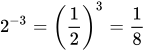
Wenn der Exponent gleich 1 2 {\displaystyle {\frac {1}{2}}}} ist, dann ist das Ergebnis der Potenzierung die Quadratwurzel der Basis. Also x 1 2 = x . {\darstellungsstil x^{\frac {1}{2}}}={\sqrt {x}}}. }
  Beispiel:
4 1 2 = 4 = 2 {\Anzeigestil 4^{\frac {1}{2}}={\sqrt {4}}}=2} 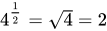
Ähnlich verhält es sich, wenn der Exponent 1 n {\darstellungsstil {\frac {1}{n}}}} ist, ist das Ergebnis die n-te Wurzel, also:
a 1 n = a n {\darstellungsstil a^{\frac {1}{\n}}={\sqrt[{n}]{a}}}} ![{\displaystyle a^{\frac {1}{n}}={\sqrt[{n}]{a}}}](https://www.alegsaonline.com/image/2153643afc258554e8acd45bd581b0b7ca74ee67.svg)
Wenn der Exponent eine rationale Zahl ist p q {\darstellungsstil {\frac {p}{q}}}}  dann ist das Ergebnis die q-te Wurzel der Basis hoch p, also
a p q = a p q {\darstellungsstil a^{\frac {p}{q}}}={\sqrt[{q}]{a^{p}}}} ![{\displaystyle a^{\frac {p}{q}}={\sqrt[{q}]{a^{p}}}}](https://www.alegsaonline.com/image/46fe16246dda1e792bae2e9db47ae5953aaf926f.svg)
Der Exponent ist vielleicht nicht einmal rational. Um eine Basis a auf eine irrationale x-te Potenz zu erhöhen, verwenden wir eine unendliche Folge von rationalen Zahlen (xi), deren Grenze x ist:
x = lim n → ∞ ∞ x n {\Darstellungsstil x=\lim _{n\bis \infty }x_{n}}} 
wie dieses:
a x = lim n → ∞ a x n {\darstellungsstil a^{x}=\lim _{n\to \infty }a^{x_{n}}}} 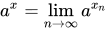
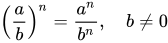
Es gibt einige Regeln, die bei der Berechnung von Befugnissen helfen:
- ( a ⋅ b ) n = a n ⋅ b n {\darstellungsstil \links(a\cPunkt b\rechts)^{n}=a^{n}\cPunkt {}b^{n}}

- ( a b ) n = a n b n , b ≠ 0 {\displaystyle \left({\frac {a}{b}}}\right)^{{n}={\frac {a^{{n}}{b^{n}}}},\quad b\neq 0}
- a r ⋅ a s = a r + s {\darstellungsstil a^{r}\cdot {}a^{s}=a^{r+s}}

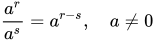
- a r a s = a r - s , a ≠ 0 {\displaystyle {\frac {a^{r}}{a^{s}}}=a^{r-s},\quad a\neq 0}
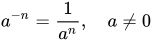
- a - n = 1 a n , a ≠ 0 {\darstellungsstil a^{-n}={\frac {1}{a^{n}}}},\quad a\neq 0}
- ( a r ) s = a r ⋅ s {\Anzeigestil \links(a^{r}\rechts)^{s}=a^{r\cdot s}}

- a 0 = 1 {\Anzeige-Stil a^{0}=1}

Es ist möglich, die Exponentiation von Matrizen zu berechnen. Die Matrix muss quadratisch sein. Zum Beispiel: I 2 = I ⋅ I = I {\darstellungsstil I^{2}=I\cPunkt I=I} .
.
Kommutativität
Sowohl Addition als auch Multiplikation sind kommutativ. Zum Beispiel ist 2+3 dasselbe wie 3+2; und 2 - 3 ist dasselbe wie 3 - 2. Obwohl die Potenzierung eine wiederholte Multiplikation ist, ist sie nicht kommutativ. Zum Beispiel, 2³=8 aber 3²=9.
Inverse Operationen
Addition hat eine inverse Operation: Subtraktion. Auch die Multiplikation hat eine inverse Operation: Division.
Aber die Potenzierung hat zwei inverse Operationen: Die Wurzel und den Logarithmus. Dies ist der Fall, weil die Potenzierung nicht kommutativ ist. Sie können dies in diesem Beispiel sehen:
- Wenn Sie x+2=3 haben, dann können Sie durch Subtraktion herausfinden, dass x=3-2 ist. Das ist dasselbe, wenn Sie 2+x=3 haben: Sie erhalten ebenfalls x=3-2. Das liegt daran, dass x+2 dasselbe ist wie 2+x.
- Wenn Sie x - 2=3 haben, dann können Sie die Division verwenden, um herauszufinden, dass x= 3 2 {\textstyle {\frac {3}{2}}}
 . Dies ist dasselbe, wenn Sie 2 - x=3 haben: Sie erhalten auch x= 3 2 {\textstyle {\frac {3}{2}}}} . Dies liegt daran, dass x - 2 dasselbe ist wie 2 - x
 - Wenn Sie x²=3 haben, dann verwenden Sie die (Quadrat-)Wurzel, um x herauszufinden: Sie erhalten das Ergebnis x = 3 2 {\textstyle {\sqrt[{2}]{3}}}}
![{\textstyle {\sqrt[{2}]{3}}}](https://www.alegsaonline.com/image/1aecee3be932de33627f90e6b497ff90ebf9b2a0.svg) . Wenn Sie jedoch 2x=3 haben, dann können Sie nicht die Wurzel verwenden, um x herauszufinden. Vielmehr müssen Sie den (binären) Logarithmus verwenden, um x herauszufinden: Sie erhalten das Ergebnis x=log2(3).
. Wenn Sie jedoch 2x=3 haben, dann können Sie nicht die Wurzel verwenden, um x herauszufinden. Vielmehr müssen Sie den (binären) Logarithmus verwenden, um x herauszufinden: Sie erhalten das Ergebnis x=log2(3).
Verwandte Seiten
- Exponent
Fragen und Antworten
F: Was ist die Potenzierung?
A: Die Potenzierung ist eine arithmetische Operation mit Zahlen, die man sich als wiederholte Multiplikation vorstellen kann.
F: Wie wird die Potenzierung geschrieben?
A: Die Potenzierung wird normalerweise als x^y geschrieben, wobei x die Basis und y der Exponent ist. Sie kann auch mit den Zeichen ^ oder ** geschrieben werden, z. B. 2^4 oder 2**4.
F: Was sind einige Beispiele für die Potenzierung?
A: Beispiele für die Potenzierung sind 5^3 = 5*5*5 = 125; x^2 = x*x; 1^x = 1 für jede Zahl x; und 4^(1/2) = sqrt(4) = 2.
F: Was bedeutet es, wenn der Exponent gleich -1 ist?
A: Wenn der Exponent gleich -1 ist, dann ist die Potenz einfach der Kehrwert der Basis (x^(-1) = 1/x).
F: Wie berechnet man eine irrationale Potenz einer Basis?
A: Um eine Basis a auf eine irrationale x-te Potenz zu heben, verwenden wir eine unendliche Folge von rationalen Zahlen (xn), deren Grenze x ist (a^x = lim n->unendlich a^(x_n)).
F: Gibt es Regeln, die das Berechnen von Exponenten erleichtern?
A: Ja, es gibt mehrere Regeln, die das Berechnen von Exponenten erleichtern. Dazu gehören (a * b) ^ n = a ^ n * b ^ n; (a / b) ^ n = a ^ n / b ^ n; a ^ r * a ^ s=a ^ (r + s); und so weiter.
Verwandte Artikel
Autor
AlegsaOnline.com Potenz (Mathematik) Leandro Alegsa
URL: https://de.alegsaonline.com/art/32995